No. 03of 22LandmarkResearch
Turns any existing camera into a smart camera
One Camera Brain
One system that takes video from cameras a site already owns, runs theft, safety and work-insight rules on it, and seals evidence clips so that tampering shows. Tested on recorded public datasets, not yet on real recorder hardware.
- When
- Sep – Nov 2026
- Status
- Built
Progress
Progress75%
The platform is built and tested on recorded public datasets. Not yet tested on real recorder hardware, and no custom model has been trained.
What comes next
- Test on a real DVR or NVR.
- Fine-tune the detector for crowds, night and fisheye views, the measured gaps.
- Record a short demo: live view, alert, sealed evidence clip.
98% / 98%
precision and recall for after-hours intrusion on a shopping-corridor dataset (CAVIAR)
One dataset of recorded footage, not a live site. On the two street datasets the same rule found 3 of 3 and 4 of 4 events.
Benchmark tables and test report (testing/results/tables.md, REPORT.md)Verified. Backed by a file or public page that has been checked.Benchmark tables and test report (testing/results/tables.md, REPORT.md) — Read in the project audit of 13 November 2026.42 of 42
camera tamper tests detected: covered, defocused and moved
Zero false raises only once the one touring PTZ camera is marked as such.
Tamper results (testing/results/tamper.json)Verified. Backed by a file or public page that has been checked.Tamper results (testing/results/tamper.json) — Read in the project audit of 13 November 2026.32.6%
recall for person detection in dense crowds (MOT20), at 95.7% precision
The weak spot. Line-crossing recall in the same crowds is 31.8%. On the less crowded MOT16 street set, detection recall is 66.7%.
Benchmark tables (testing/results/tables.md)Verified. Backed by a file or public page that has been checked.Benchmark tables (testing/results/tables.md) — Read in the project audit of 13 November 2026.9.8ms
median detector time for one 1080p frame (YOLOX-s through CoreML)
On an Apple M3 Ultra with tiling off: about 16 cameras at 5 frames a second per worker. With every frame tiled, the worst case, it is 49.2 ms.
Speed benchmark (testing/results/speed.json)Verified. Backed by a file or public page that has been checked.Speed benchmark (testing/results/speed.json) — Read in the project audit of 13 November 2026.439
automated tests passing, 1 skipped
From the latest test log. The project's own test report of 2 November 2026 counted 430.
Test log (testing/results/pytest_models2.log)Verified. Backed by a file or public page that has been checked.Test log (testing/results/pytest_models2.log) — Read in the project audit of 13 November 2026.83.9 / 100
the project's own overall score with the models it runs today
A self-defined score. It would be 86.6 with the best models that may be used commercially, and 91.6 with the best non-commercial ones.
Overall score file (testing/results/overall_score_models2.json)Verified. Backed by a file or public page that has been checked.Overall score file (testing/results/overall_score_models2.json) — Read in the project audit of 13 November 2026.Exhibit 01 · Scorecard
The benchmark, weak rows included
Measured on recorded public datasets through the product's own code, with one generic zone layout for every video. The two street datasets (MOT16, MOT20) are licensed for non-commercial use and served for evaluation only. Nothing here was measured on a live site or on real recorder hardware.
| Measure | Result | Note | Source |
|---|---|---|---|
| After-hours intrusion, shopping corridor (CAVIAR) | 98% precision / 98% recall | 50 true events. | Benchmark tables B3 |
| After-hours intrusion, street (MOT16 and MOT20) | 3 of 3 and 4 of 4 events | Seven events in all: too few for a percentage. | Benchmark tables B3 |
| Restricted-zone entry, corridor (CAVIAR) | 97.2% precision / 94.6% recall | Benchmark tables B3 | |
| Restricted-zone entry, street (MOT16) | 94.4% precision / 92.7% recall | Benchmark tables B3 | |
| Restricted-zone entry, dense crowds (MOT20) | 96.9% precision / 80.7% recall | Benchmark tables B3 | |
| Person detection, corridor (CAVIAR) | 89.8% precision / 78.3% recall | Strict matching against boxes drawn by people. | Benchmark tables B1 |
| Person detection, street (MOT16) | 88.0% precision / 66.7% recall | Benchmark tables B1 | |
| Person detection, dense crowds (MOT20) | 95.7% precision / 32.6% recall | Weak spot: two of three people in a crowd are missed. | Benchmark tables B1 |
| Line crossing, dense crowds (MOT20) | 31.8% recall | Weak spot: tracks break in crowds. | Benchmark tables B3 |
| Person down (UR Fall) | 53% of lying frames | Weak spot. Specificity is 99.8%. | Benchmark tables B5 |
| Camera tamper: covered, defocused, moved | 42 of 42 detected | Zero false raises once the one touring PTZ camera is marked. | Tamper results |
| Whole-node run on 28 surveillance cameras (MEVA) | 118 events from 28 cameras × 120 s | Every event had a sealed clip and the ledger verified intact. | Test report B6 |
| Zone alerts in that run, checked by a person | 56 of 57 sampled alerts real (98.2%) | From a manual review of stills, by eye. Not a labeled benchmark. | Test report, 2 November 2026 |
| Detector speed, 1080p frame | 9.8 ms median, 10.6 ms at the 95th percentile | YOLOX-s, CoreML, Apple M3 Ultra, tiling off: about 16 cameras at 5 frames a second per worker. | Speed benchmark |
| Alert verifier (vision-language model) | accuracy 1.00 on 58 clips, 3.29 s median | A small sample, and the prompt was tuned on the same clips with no held-out set. Not a general accuracy. | Verifier benchmark |
| Cloud load test | 8,000 simulated nodes: notify in 0.03 s median, 0.04 s at the 99th percentile | Simulated nodes, not cameras in the field. | Cloud-cell benchmark |
| Platform test suite | 439 passed, 1 skipped | Latest log. The test report of 2 November counted 430. | Test log |
| Overall system score | 83.9 / 100 | The project's own score: 86.6 with the best commercially usable models, 91.6 with the best non-commercial ones. | Overall score file |
Exhibit 02 · Chart
Recall: where it holds and where it breaks
Exhibit 03 · Gallery
The app, with no camera footage on screen
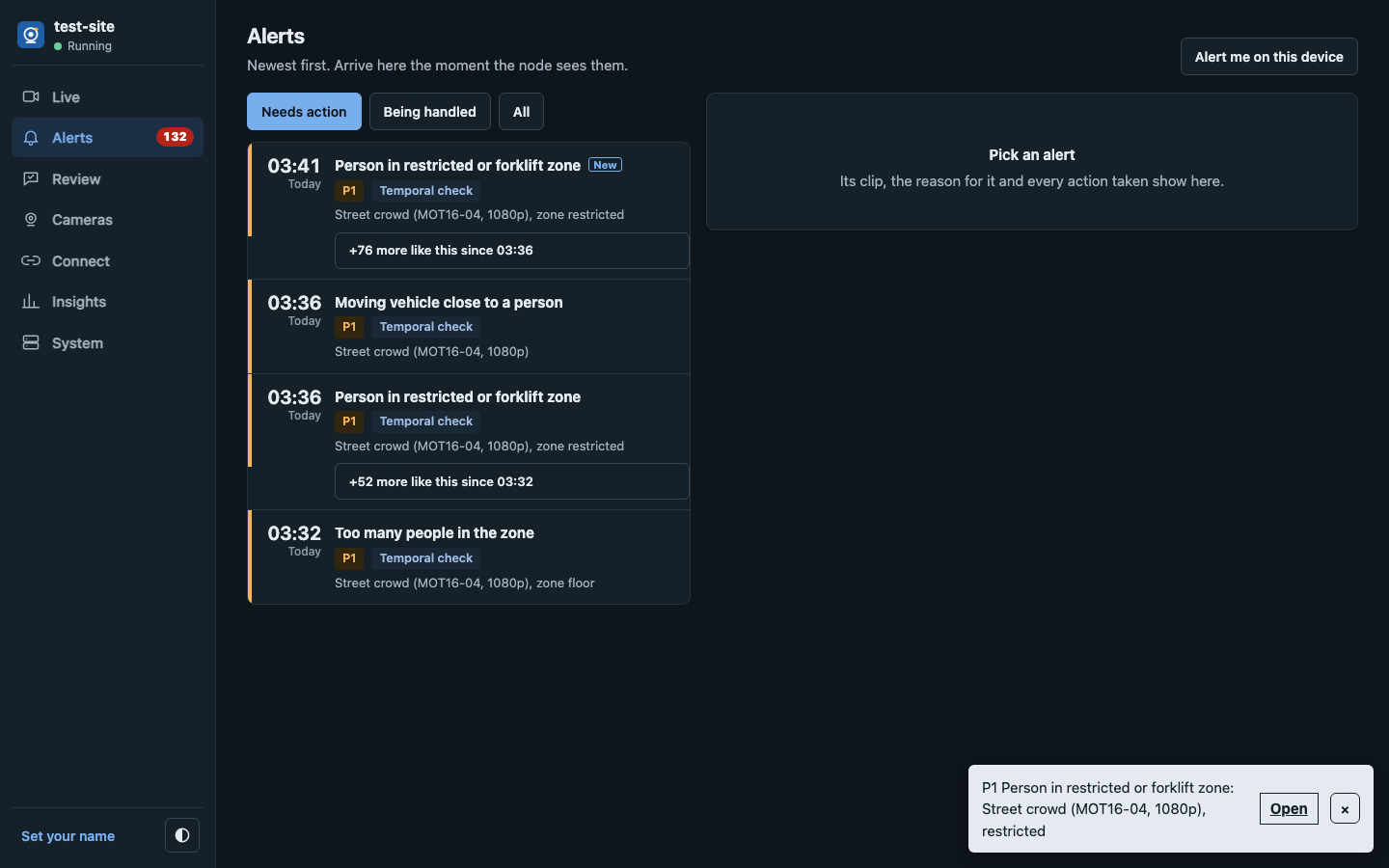
A generic zone drawn over a busy street raised one alert per pedestrian. Grouping, one of the 22 fixes, turns 132 alerts into four rows. 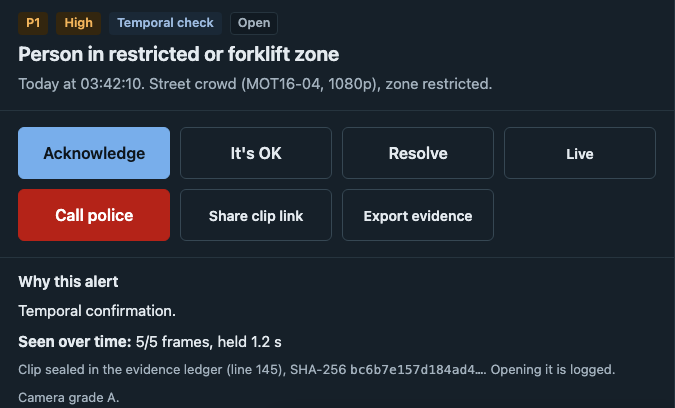
An alert says why it fired and where its sealed clip sits in the ledger. The video still is cropped out, because it is dataset footage of real people. 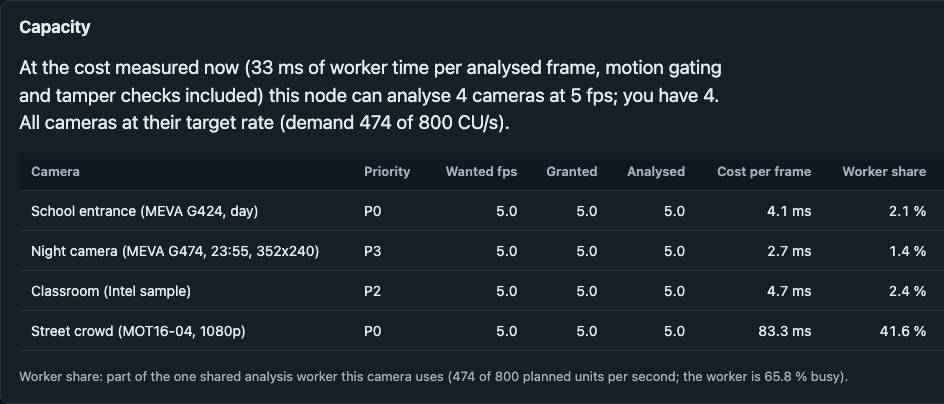
The app states what the node can carry. A tiled 1080p street camera costs 83 ms a frame here, far above the 9.8 ms full-frame figure, and the page says so. 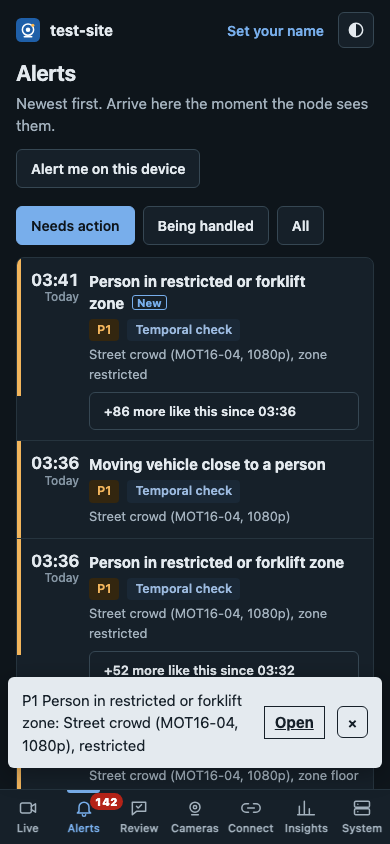
The same app on a phone.
01
What it is
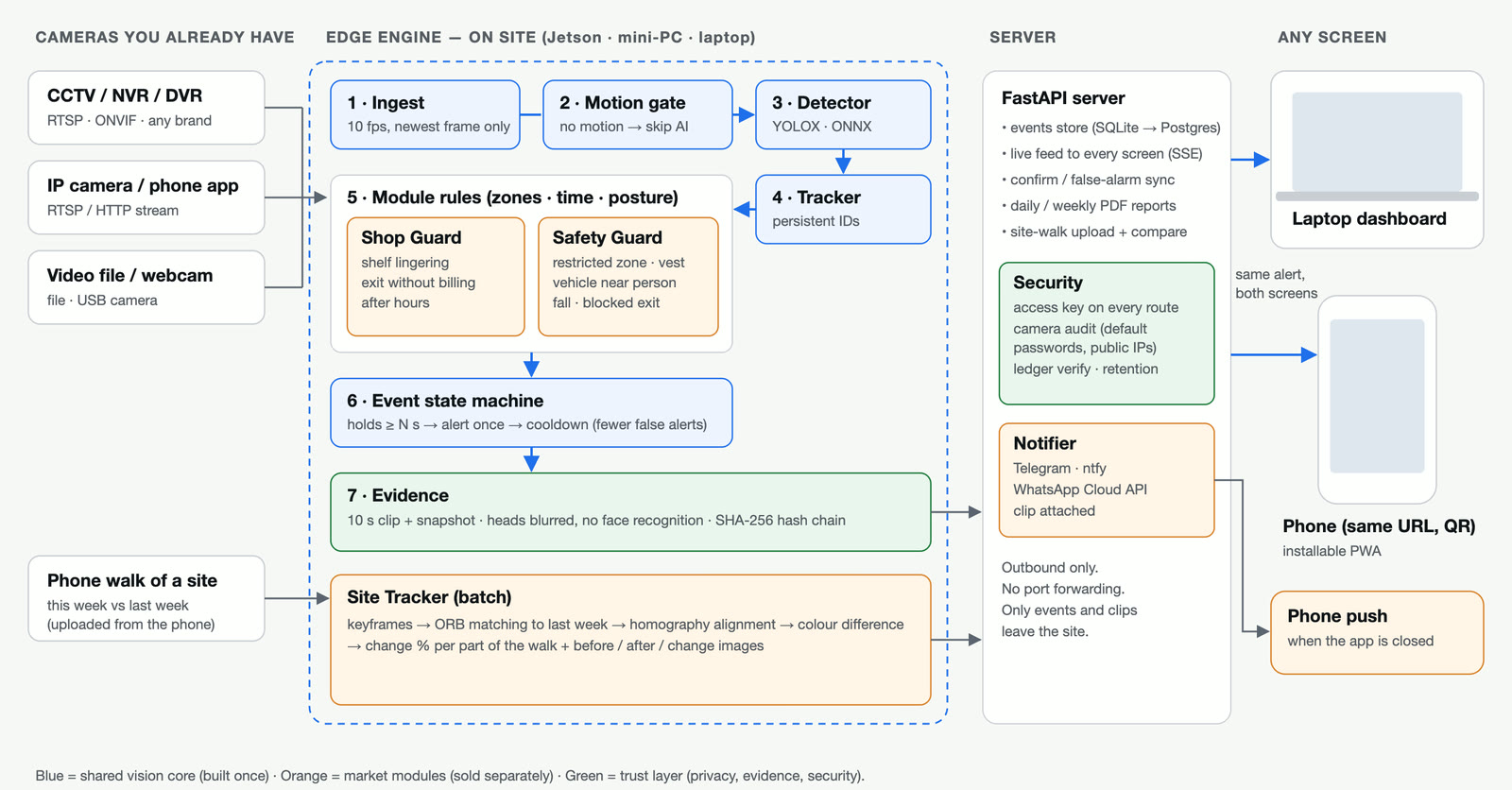
One Camera Brain is software that turns the cameras a site already has into smart cameras: analog cameras behind a recorder, IP cameras, cloud cameras or a phone. It runs three packs of rules (theft and intrusion, safety, and work insights), grades what each camera is good enough for, seals a signed evidence clip for every alert, and can feed its results back into the site's existing camera software as a virtual camera. It was built to a startup brief, first as a small prototype and then as a much larger platform.
02
The hard part
Other people's cameras. A rule such as "someone is in the restricted zone" is only as good as the detector underneath it, and off-the-shelf detectors miss people who are small, distant or packed into a crowd. Running the product on real footage found 22 problems, each fixed with a test that fails without the fix. A person standing still when the camera started was never detected. Small people on high-definition cameras were missed until the frame was also analyzed in tiles. Video from older recorders could not be read at all. And the brief asked for 98 to 100% accuracy, which the measurements support on some rules and plainly do not on others.
03
What was built
A platform of about 21,400 lines of Python with 10,200 lines of tests. A rules engine with the three packs. Connectors for ONVIF cameras, go2rtc streams and phone cameras. Perception: YOLOX and RF-DETR detectors run through ONNX Runtime, tiled detection for small people, a tracker, and a small vision-language model that double-checks an alert. An evidence ledger in which every clip is hash-sealed and signed, so a changed or missing clip shows. Ways out through MQTT, webhooks and the virtual camera. Around that, a node runtime, a local app for desktop and phone, and the layers for a site cluster and a cloud service. No model was trained for it: every detector is used as released.
04
What was measured
Everything was measured on recorded public datasets, through the product's own code. After-hours intrusion: every event found on two street datasets (3 of 3 and 4 of 4), and 98% precision and recall on a shopping-corridor dataset. Restricted-zone entry on the corridor: 97.2% precision, 94.6% recall. Camera tampering: 42 of 42 detected. The detector takes 9.8 ms for a 1080p frame on an Apple M3 Ultra with tiling off.
The weak spots are reported by the project itself. In dense crowds the detector finds a third of the people (32.6% recall) and line-crossing recall is 31.8%. A person lying on the ground is recognized in 53% of frames. Night and fisheye scenes are worse than daylight ones. The overall score the project gives itself is 83.9 out of 100.
05
What's next
A test on a real DVR or NVR, which has not happened yet. A detector fine-tuned for crowds, night and fisheye views, because those are the measured gaps. A recorded demo, from live view to alert to sealed clip. Also not done: adapters for consumer cloud cameras are untested, and web push, talk-down audio, PTZ presets and tracking across cameras are not built.
Figures
One question
The answer is on this page. Get it right and it goes in your passport on the map.
Challenge· stamped
In footage of dense crowds, what share of the people does the detector actually find?
32.6% recall on the MOT20 crowd dataset, at 95.7% precision: it is rarely wrong about a person it reports, but it misses two of three. Source: the project's benchmark tables.
Show the answer
About 33%. 32.6% recall on the MOT20 crowd dataset, at 95.7% precision: it is rarely wrong about a person it reports, but it misses two of three. Source: the project's benchmark tables.
- Stack
- Python
- FastAPI
- ONNX Runtime (CoreML)
- YOLOX
- RF-DETR
- BoT-SORT-style tracking
- qwen3-vl (Ollama)
- go2rtc
- PyAV and FFmpeg
- SQLite
- Postgres and pgvector
- MQTT
- ONVIF
- Ed25519 signatures