No. 02of 22LandmarkResearch
Legal NLP research and a platform for Indian law
LawVerse
A legal research platform for Indian law, and the study behind it. Across 231,908 court judgments, our first pipeline said 22 of 25 legal concepts had changed in meaning. After we found and fixed four silent defects in it, one did.
- When
- Mar – Nov 2026
- Status
- Research
- Team
- RV University computer science capstone project, built by a team.
- Role
- Co-author of the paper. Listed as team lead and full-stack developer in the project README.
Progress
Progress75%
Research pipeline, citation graph, website, gateway and Android app all run locally. Not deployed publicly; the paper is under revision.
What comes next
- Revise and resubmit the paper.
- Add review cases that are real and verified by a lawyer, not synthetic.
- Deploy the platform behind HTTPS so the app can connect to it.
22 → 1
of 25 concepts read as changing, before and after the pipeline was corrected
The 22 is counted without the reliability floor, which the original pipeline can never pass; the 1 is counted with it. Without the floor, the corrected pipeline reads 7 of 25.
Workshop manuscript and result files, August 2026Verified. Backed by a file or public page that has been checked.Workshop manuscript and result files, August 2026 — The paper is not public: submitted to NLLP @ EMNLP 2026, not accepted, under revision.231,908
court judgments in the corpus
99.7% Indian. The 800 US documents are too few for any cross-country comparison.
Workshop manuscript and result files, August 2026Verified. Backed by a file or public page that has been checked.Workshop manuscript and result files, August 20261 → 24
of 25 concepts flagged, from changing only which tokens are pooled
Workshop manuscript and result files, August 2026Verified. Backed by a file or public page that has been checked.Workshop manuscript and result files, August 202699.7% vs 23.7%
concept-identification accuracy: the corrected representation against [CLS] pooling
Nearest-centroid probe over 25 concepts. Chance is 4%.
Workshop manuscript and result files, August 2026Verified. Backed by a file or public page that has been checked.Workshop manuscript and result files, August 202698.8%
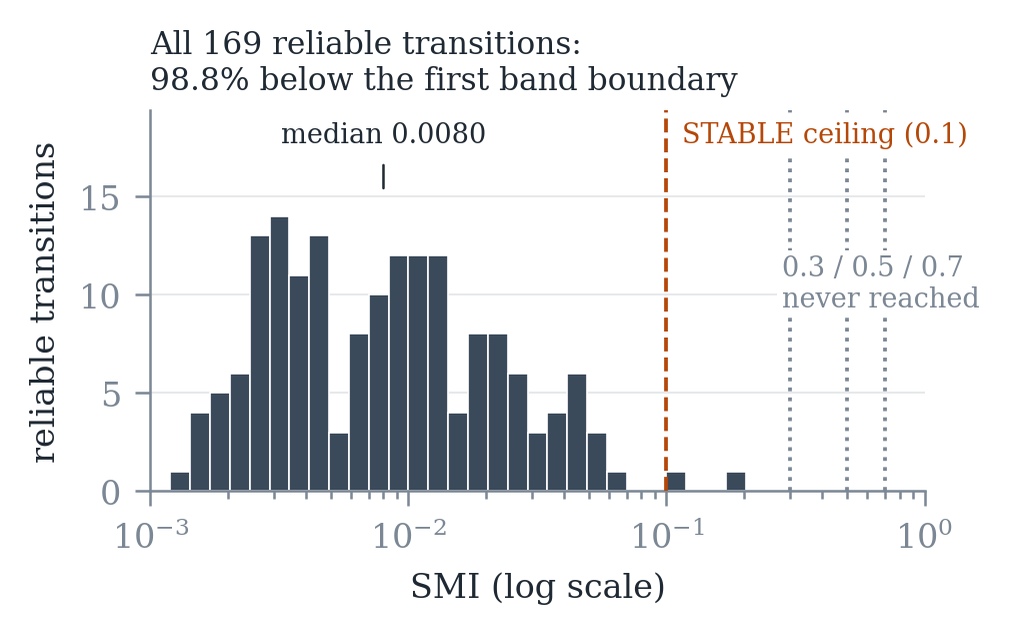
of 169 reliable decade-to-decade transitions fall in the lowest drift band
Workshop manuscript and result files, August 2026Verified. Backed by a file or public page that has been checked.Workshop manuscript and result files, August 2026115,537
cases in the citation graph, joined by 67,864 citation links
Built from the indexed corpus only. How a later court treated a case is inferred from cue phrases near the citation.
Citation build log (build_citations.log)Verified. Backed by a file or public page that has been checked.Citation build log (build_citations.log) — Read in the project audit of 13 November 2026.Exhibit 01 · Live demo
Live demo
Exhibit 02 · Compare
One estimator, three verdicts
Original pipeline
22 of 25
concepts read as changing. Four silent defects were at work, and none raised an error. Counted without the reliability floor, which this pipeline can never pass.
Corrected pipeline
1 of 25
Window centered on the mention, exact phrase matching, no fallback, one vector per document. Counted with the reliability floor; without it, the corrected pipeline reads 7 of 25.
Corrected, [CLS] pooling
24 of 25
Nothing changed except which token positions are pooled. This representation identifies the right concept 23.7% of the time, against 99.7% for the corrected one. Chance is 4%.
From the paper's ablation and probe result files. Same data and same concepts in every state.
Exhibit 03 · Gallery
The Android app, GLaw
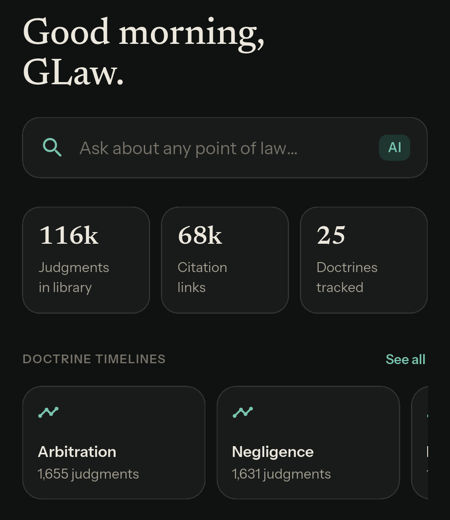
Home screen of a local build. The counters match the citation database: 115,537 cases and 67,864 links. 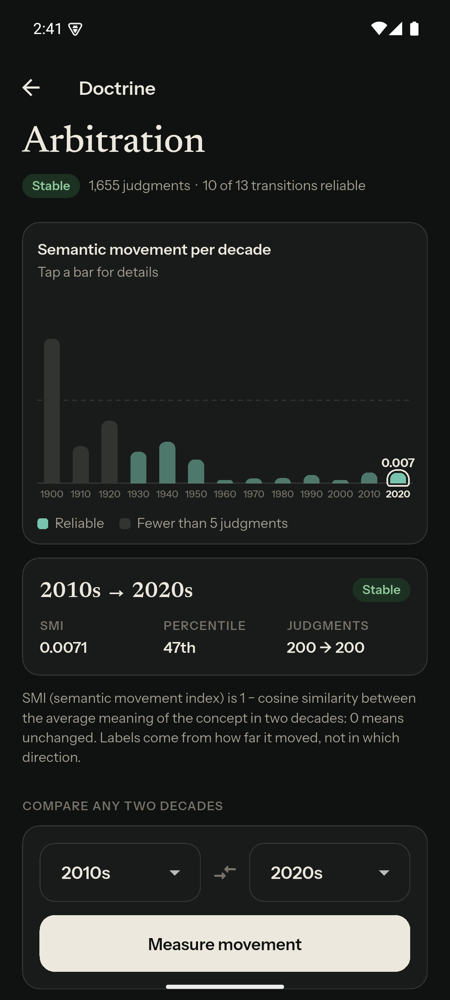
A doctrine timeline. Decades with fewer than five judgments are marked unreliable, not drawn as drift. 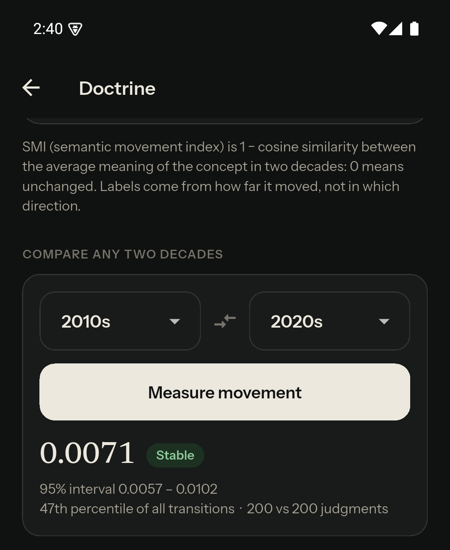
Every comparison shows its interval and its sample sizes. 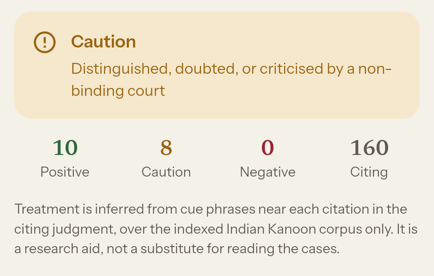
The good-law check for one Supreme Court case, cropped to leave out party names. The app says what its label is inferred from.
Exhibit 04 · Scorecard
Document review: the best run of 60 cases
The test cases are synthetic, and this best run is still just below the project's own release gate (at least 98% of serious defects caught). A later run the same day had provider failures, with no model response on 48 of 60 cases, so it is not counted as an accuracy figure.
| Measure | Result | Note | Source |
|---|---|---|---|
| Document type named correctly | 98.4% | Synthetic cases. | Evaluation run of 10 November 2026 |
| Serious defects caught | 95.8% | Below the release gate of 98%. Not passed. | Evaluation run of 10 November 2026 |
| Quoted passages that are valid | 97.0% | Each finding must quote the text it rests on. | Evaluation run of 10 November 2026 |
| Redaction leaks | 0 | Identity numbers such as Aadhaar must stay redacted in the output. | Evaluation run of 10 November 2026 |
| Cost of a 10-page scan | ₹1.69 | Evaluation run of 10 November 2026 | |
| Median time for a review | 9.8 s | Evaluation run of 10 November 2026 |
01
What it is
The Semantic Movement Index, SMI, is a simple estimator. Embed every mention of a legal phrase such as "due process" or "bail", average the vectors within a decade, and take one minus the cosine similarity between two decades. We ran it over 231,908 judgments, 99.7% of them Indian, with a legal-domain encoder.
LawVerse is the platform built around it: search over Indian judgments by meaning, a citation graph that shows how later courts treated a case, doctrine timelines for 25 legal concepts, and an AI review of contracts and property documents. Its Android app is called GLaw.
02
The hard part
The first build produced a striking result, complete with confidence intervals, and it was wrong. Four defects were responsible, and none of them raised an error or a warning. The text window was cut from the start of each judgment, so it usually did not contain the concept at all. The matcher matched loose words instead of the phrase. A fallback gave every unmatched decade the same vector. And the bootstrap resampled a single row, so every interval had zero width by construction. With no annotated benchmark for legal concept drift, nothing outside the pipeline could tell us it was broken.
03
What was built
A corrected pipeline: the window centered on the mention, contiguous phrase matching, no fallback, and one vector kept per document. Build-time checks that fail when two periods share a vector or an interval has zero width. A controlled ablation that changes one design choice at a time on identical data. A cheap probe that asks whether a representation can tell which concept it came from.
Around it, the platform. A cleaned corpus and a citation database of 115,537 cases joined by 67,864 citation links, with a label for how later courts treated each case. Semantic search. A document review in which a language model reads contracts and Indian property documents in 12 languages, quotes the passage behind each finding and redacts Aadhaar numbers. A FastAPI gateway, a Next.js website, an admin dashboard, and a Flutter Android app with a document scanner.
04
What was found
Rebuilt from the old code, the original pipeline labels 22 of 25 concepts as changing. The corrected one labels 1. The defects interact: the fallback alone corrupts 3.0% of cells, but 19.6% once the bad window is added. One defect turned out to be plainly wrong and yet harmless on everything we could measure, and we report it that way. The largest effect was not a bug at all. Changing only which token positions are pooled swings the verdict from 1 to 24 of 25, and the most dramatic drift comes from the representation that is worst at identifying a concept (23.7% against 99.7%). Measured correctly, 98.8% of the 169 reliable decade-to-decade transitions sit in the lowest band.
The document review has its own evaluation harness with a release gate. On its best run of 60 cases it named the document type correctly 98.4% of the time and caught 95.8% of serious defects. Those cases are synthetic, and 95.8% is just below the gate of 98%, so the review has not yet passed its own bar.
05
What it does not claim
The study is a negative result with a fix. Its paper, "When the Metric Measures the Bug", was submitted to NLLP @ EMNLP 2026, not accepted, and is under revision. It makes no cross-country claim, because only 800 documents are from the US and none are European. It reports no retrieval benchmark, because no annotated query set exists. The platform and the app run on local machines; nothing is deployed publicly. Earlier descriptions of this project, including its public README, carry figures from before the correction; this page is the current account. The next research steps are the ones the paper names: repeat the measurement with other encoders, and build an annotated benchmark for legal concept drift.
Figure
One question
The answer is on this page. Get it right and it goes in your passport on the map.
Challenge· stamped
The first pipeline said 22 of 25 legal concepts had changed in meaning. After four silent defects were fixed, how many did?
1 of 25. Rebuilt from the old code, the original pipeline flags 22; the corrected one flags 1, counted with its reliability floor. Source: the paper's ablation result file.
Show the answer
1 of 25. 1 of 25. Rebuilt from the old code, the original pipeline flags 22; the corrected one flags 1, counted with its reliability floor. Source: the paper's ablation result file.
- Stack
- Python
- PyTorch
- Hugging Face Transformers
- LexLM legal-RoBERTa-large
- BGE-large-en-v1.5
- FastAPI
- SQLAlchemy and SQLite
- Gemini (Groq as fallback)
- Next.js
- React
- Flutter
- ML Kit