No. 18of 22WaypointSoftware
Document to question-and-answer REST API
Doc2QA API
A REST API that turns PDF, DOCX or plain-text documents into study question-and-answer pairs in four modes, with API keys, plan tiers, usage metering and rate limits. The questions come from rules and heuristics, self-hosted, with no outside AI service.
- When
- Dec 2025
- Status
- Built
- Team
- Personal project.
- Role
- Sole builder.
Progress
Progress70%
Deployed on Render in December 2025; whether it is still up is not known. The RapidAPI listing was never made public, and 27 of 105 tests were failing at the last run.
What comes next
- Check whether the deployment still answers before linking it.
- Measure the quality of the generated questions; no metric exists yet.
- Fix the 27 failing tests.
27 of 105
tests failing at the last recorded run
Test cache of the last run (.pytest_cache, lastfailed)Verified. Backed by a file or public page that has been checked.Test cache of the last run (.pytest_cache, lastfailed) — Read in the project audit of 13 November 2026.Not measured
quality of the generated questions and answers
No quality metric exists for the output, so none is claimed.
Project write-up, verified results sectionVerified. Backed by a file or public page that has been checked.Project write-up, verified results section — Read in the project audit of 13 November 2026.Exhibit 01 · Scorecard
What is evidenced, and what is not
A three-day build. This is the state of the evidence, without rounding up.
| Measure | Result | Note | Source |
|---|---|---|---|
| Deployed | Answered on 19 December 2025 | Two manual test runs of the health endpoint returned success that night. Whether it answers today is not known. | RapidAPI test screenshot, 19 Dec 2025 |
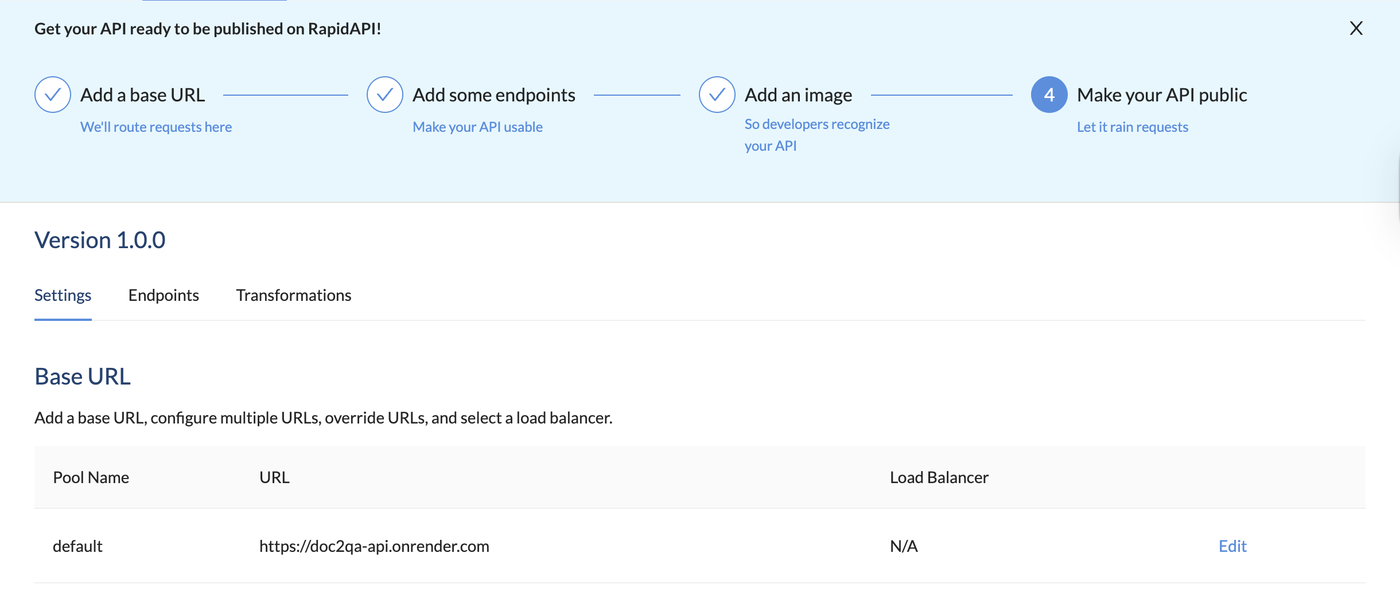
| Marketplace listing | Prepared, not public | The provider dashboard shows the final step, making the API public, not done. Plan prices are settings, not sales. | RapidAPI provider dashboard screenshot |
| Tests | 105, with 27 failing | At the last recorded run. | .pytest_cache, lastfailed |
| Question generator | Rules and heuristics | NLTK, TF-IDF similarity and hand-built subject modules. No language model and no outside AI service. | Project source, as audited |
| Output quality | Not measured | No quality metric exists for the generated questions and answers. | Project audit, November 2026 |
01
What it is
Doc2QA is a REST API that turns a document into study questions and answers. You send a PDF, a DOCX file or plain text and get back question-and-answer pairs in one of four modes. It is a personal build from three days in December 2025, aimed at everything a paid API needs around its core: keys, plan tiers, usage metering, rate limits and abuse controls.
02
What was built
A FastAPI service of about 8,000 lines: document ingestion, four generation modes, API-key sign-in, plan tiers, usage metering, rate limiting and abuse controls, on async SQLAlchemy with Alembic migrations. The questions come from rules and heuristics, not a language model: NLTK, TF-IDF similarity and hand-built modules for subjects such as physics, law and medicine. Nothing is sent to an outside AI service. It comes with an OpenAPI specification, a Docker image and 105 tests.
03
Where it stands
It was deployed on Render, and on the night of 19 December 2025 its health endpoint answered two manual test runs. Whether it is still up is not known, so it is not linked here. A RapidAPI listing was prepared, with plan tiers configured, but never made public. At the last recorded run, 27 of the 105 tests were failing. Nothing measures how good the generated questions are.
04
What I'd change
Measure the output first: a small set of documents with questions a person would accept, and a score against it. Then fix the failing tests, and either publish the listing or retire it.
Figures
One question
The answer is on this page. Get it right and it goes in your passport on the map.
Challenge· stamped
Doc2QA writes study questions from a document. What writes them?
Rules and heuristics: NLTK, TF-IDF similarity and hand-built subject modules, all self-hosted, per the project's source as audited in November 2026.
Show the answer
Rules and heuristics, with no AI service at all. Rules and heuristics: NLTK, TF-IDF similarity and hand-built subject modules, all self-hosted, per the project's source as audited in November 2026.
- Stack
- Python
- FastAPI
- SQLAlchemy (async)
- Alembic
- PostgreSQL / SQLite
- NLTK
- scikit-learn (TF-IDF)
- Docker
- Render
- OpenAPI